
























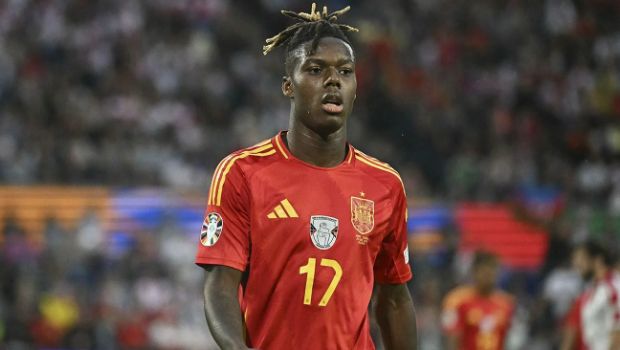
Spain’s celebration after winning the 2026 FIFA World Cup produced countless unforgettable images.
None carried more emotion than the moment Nico Williams walked straight toward the stands after receiving his winners’ medal. Instead of keeping it around his own neck, the Spanish winger removed it and placed it around his mother’s shoulders.
It was far more than a celebration.
It was a tribute to the woman who made his football dream possible.
Williams had already played a decisive role in Spain’s triumph.
With the World Cup final against Argentina locked in a scoreless battle, the Athletic Club star helped create the tournament’s defining moment. In extra time, Nico headed the ball into the path of Ferran Torres, whose finish secured a 1-0 victory and Spain’s second World Cup title. Earlier in the match, Williams had also found the net, but his goal was ruled out after a foul in the buildup.
As memorable as his assist was, the story after the final became even more powerful.
Following the medal ceremony, Williams sought out his mother, María Comfort Arthuer, in the crowd before placing his gold medal around her neck. He later explained why the gesture meant so much.
Williams said he runs very fast, but never as fast as his mother, who escaped death while crossing the Sahara Desert from Ghana to Spain. He added that she deserved the medal more than anyone because her courage made his career possible.
The story behind those words is extraordinary.

In the mid-1990s, María Comfort Arthuer and her husband, Félix Williams, left Ghana searching for safety and a better future. Their journey became a fight for survival. After being abandoned during the migration route, they crossed stretches of the Sahara under extreme conditions before eventually reaching Melilla in Spain.
María completed much of that journey while pregnant with Nico’s older brother, Iñaki Williams. The family later settled in the Basque Country, where both sons would eventually develop into elite footballers.
For Nico, the medal represented far more than a football achievement.
It symbolized decades of sacrifice, resilience and hope that began long before he ever stepped onto a professional pitch.
His brother, Iñaki Williams, who played in this World Cup for Ghana, also celebrated the moment, calling Nico’s achievement a source of pride not only for their family but for immigrants who left everything behind in search of a better life.
World Cup medals are usually remembered as rewards for greatness on the field.
Nico Williams chose to remind the world that some victories begin long before kickoff.
For him, the greatest champion in the family was waiting in the stands.