


























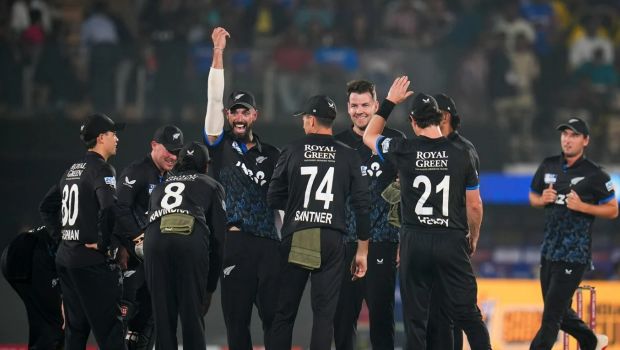
The Super 8 stage of the ICC T20 World Cup 2026 has already seen some exciting contests, and the upcoming clash between New Zealand and Sri Lanka at the R. Premadasa Stadium in Colombo promises to be a pivotal encounter.
With both sides eyeing crucial points to stay alive in the race to the semifinals, the stakes could not be higher. For New Zealand, it is about gaining momentum and finally opening their Super 8 account in style; for Sri Lanka, it is nothing short of a do-or-die battle on home soil.
From New Zealand’s perspective, the campaign has been competitive but not entirely smooth. They won their first two games in the group stage before South Africa proved to be their first big obstacle. They nevertheless made it to the next round and were looking to get better of Pakistan in the first game of the Super 8 stage but then came the rains. A washout against Pakistan a few days ago meant that Mitchell Santner’s men had to settle for a solitary point.
While a shared point keeps them afloat, it also increases the urgency to convert opportunities into wins. In tournaments like this, especially in the Super 8 phase where margins are slim, dropped points—no matter the reason—can prove costly. The Kiwis have otherwise looked like a well rounded unit in the tournament. Their batting has shown composure, their pace attack has carried bite, and their fielding standards remain among the best in world cricket.
Santner’s leadership has been calm and tactically astute so far. As captain, he has rotated his bowlers cleverly and adapted to different conditions. However, the challenge of cracking the Super 8 stage remains. Historically, New Zealand have often thrived in global tournaments, but this edition demands sharper execution in crunch moments.
New Zealand would be happy to get Lockie Ferguson back in the XI to bolster their attack. Ferguson’s pace and ability to generate steep bounce make him a genuine wicket-taking option, particularly on surfaces that offer even a hint of carry. His presence alongside the likes of Matt Henry gives New Zealand the ability to strike early and apply sustained pressure in the middle overs.
Team combination will be a critical factor. Leggie Ish Sodhi was included in the XI in the previous match against Pakistan, especially considering that the surface in Kandy was expected to assist spinners. With that match abandoned, it remains to be seen whether the think tank opts for a similar spin-heavy approach in Colombo or leans towards a pace-dominant attack. The Premadasa surface traditionally offers assistance to spinners as the game progresses, but it can also reward disciplined seam bowling under lights. I think Kiwis will take the final call between Jacob Duffy and Sodhi after looking at the wicket. Santner himself plays a dual role as captain and frontline spinner, and his utilization will be key in countering Sri Lanka’s middle order.
New Zealand’s opening pair Finn Allen and Tim Seifert has been among the brighter aspects of their campaign. They have provided solid platforms, allowing the middle order to build rather than rebuild. The batting unit, in general, has shown the ability to accelerate when required. Power hitting in the death overs and sensible strike rotation through the middle have kept them competitive totals. Yet, the Super 8 demands consistency. One underwhelming outing with the bat could shift the balance dramatically, particularly against a side as spirited as Sri Lanka.
For Sri Lanka, the journey to this stage has been marked by promise and moments of brilliance. They played impressive cricket through the group phase, displaying discipline with the ball and flair with the bat. However, their first Super 8 encounter against England exposed certain frailties. While their bowlers did a commendable job of restricting the opposition and maintaining pressure, the batting

unit failed to fully capitalize on the platform laid out. Chasing or setting targets in the Super 8 requires a fearless approach, and that is something Sri Lanka will be desperate to rediscover.
Pathum Nissanka has been one of the standout performers for the hosts. His magnificent hundred against Australia in the group stage was a masterclass in controlled aggression. The innings not only underlined his technical prowess but also his temperament in high-pressure situations. The elegance and authority with which he constructed that knock drew inevitable comparisons to Sri Lankan great Aravinda de Silva, particularly recalling de Silva’s iconic century in the 1996 ODI World Cup final against Australia. While eras and formats differ, the similarities in shot selection and composure were striking. Nissanka’s form will be central to Sri Lanka’s hopes of posting or chasing a competitive total against New Zealand.
The Sri Lankan batting line-up possesses depth and versatility. Kusal Mendis brings aggression at the top, capable of taking the game away during the powerplay. Kamindu Mendis offers adaptability in the middle order, able to anchor or accelerate depending on the match situation. Captain Dasun Shanaka remains a crucial figure, not only for his all-round abilities but for his leadership. Shanaka’s capacity to chip in with vital overs and contribute with the bat makes him indispensable. In a must win scenario, his decision-making under pressure will shape the team’s approach.
On the bowling front, Dushmantha Chameera’s fitness will be a key figure. Though he has had his share of injury concerns, Chameera at full tilt provides Sri Lanka with genuine pace and wicket-taking threat. His ability to bowl hard lengths and execute yorkers in the death overs can trouble even the most composed batting units. Watch out for Dunith Wellalage, the left-arm orthodox bowler who is very impressive. Alongside a capable spin attack and disciplined seamers, Sri Lanka have the tools to challenge New Zealand’s batting depth.
Colombo’s conditions could add another layer of intrigue. The R. Premadasa Stadium has often produced competitive totals, but it also rewards teams that read conditions quickly. Dew may play a role in the second innings, influencing captains at the toss. Both teams have bowlers who rely on grip and variations, so adaptability will be crucial.
Ultimately, this contest is not just about two points; it is about momentum and belief. For New Zealand, a victory would validate their steady campaign and ease the pressure after they lost one point due to washout against Pakistan.
For Sri Lanka, it is a chance to revive their Super 8 aspirations and energise home supporters. With in-form batters, potent pace attacks, and experienced leaders on both sides, the stage is set for a high-intensity showdown.