

























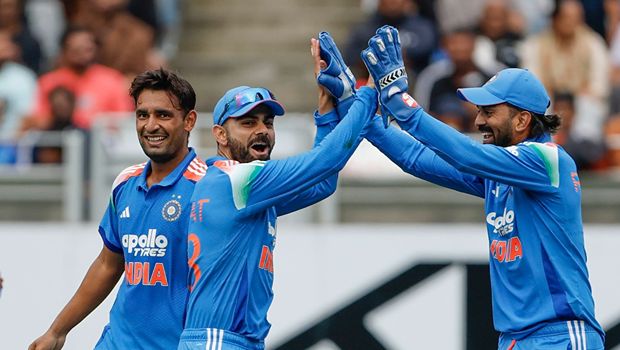
After conceding far too many runs in the five T20Is, India’s ODI team finally produced a bowling performance to take plenty of heart from. The victory at Eden Park was built on an excellent effort from the pace attack, intelligent captaincy from Shubman Gill and a composed chase led by Virat Kohli.
The biggest positive was India’s reading of the conditions. Recognising that Eden Park would favour pace over spin, the team management opted for four specialist fast bowlers, with Axar Patel taking care of the spin overs. The decision paid handsome dividends, with the pace attack accounting for nine wickets.
There was also an outstanding piece of fielding from Rohit Sharma, whose run-out of the dangerous Daryl Mitchell was an important moment in New Zealand’s innings.
Credit must go to Gill for his bowling changes as well. He completed the overs of Arshdeep Singh and Anshul Kamboj before turning to Gurnoor Brar for his tenth over. With New Zealand struggling, Gill wanted to bring his pacers back and finish the innings quickly.
Barring his final over, in which Blair Tickner smashed three sixes, Arshdeep was impressive. He used the short ball intelligently, picking up two wickets with bouncers. Gurnoor Brar made an immediate impact, striking twice upfront. Auqib Nabi, meanwhile, went wicketless and appeared to lack the pace required to trouble the New Zealand batters consistently.
For me, Kamboj was the standout performer. He bowled stump-to-stump, kept attacking the batters and rarely offered them an opportunity to score freely. His figures of 2/22 were thoroughly deserved.

The pitch offered little swing and was relatively flat, but it did not allow the New Zealand batters to score easily. India built pressure through disciplined bowling, forcing a succession of false shots. The fielding was also considerably better than what we witnessed during the T20Is. Naman Dhir did drop a straightforward catch, but Rohit, Kohli and Shreyas Iyer contributed some excellent work in the field.
India’s response with the bat was a mixed bag, around two rain interruptions. After Rohit fell cheaply, Kohli took charge, scoring 74 and adding 114 runs with Gill, who contributed 37. With the target revised to 143 in 32 overs under the DLS method, India struggled after Kohli’s dismissal, with Axar and Iyer looking all at sea, but still completed the chase with five wickets in hand.
Overall, this was a much-needed turnaround. India got their bowling combination right, executed their plans well and looked a far more disciplined unit.
New Zealand 185 all out (40.2 overs); India 146/5 (22.4 overs). India won by five wickets (DLS method).