


























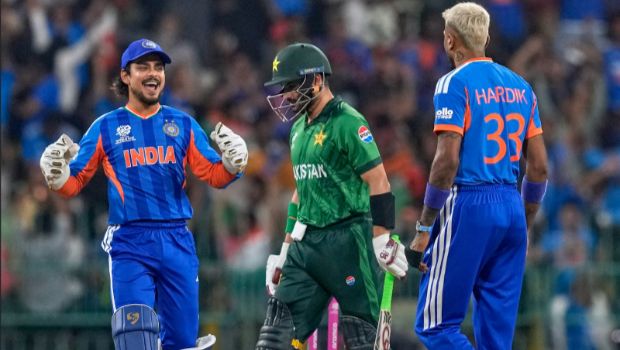
India stretched their unbeaten run against Pakistan at ICC events to 11-0 since 2021, sealing a commanding 61-run victory in Colombo to book their place in the Super Eights of the T20 World Cup.
In high-pressure contests, this Indian side invariably finds a hero. On Sunday, it was Ishan Kishan. On a sluggish pitch where timing was a luxury and fluency scarce, Kishan’s 77 off 40 balls was a decisive, match-defining innings. While the rest of India’s batting line-up laboured, he counter-attacked with clarity and control.
Abhishek Sharma fell early, miscuing to mid-off in the opening over. Tilak Varma struggled for rhythm. Yet Kishan set the tone immediately — a savage pull off Shaheen Afridi signalled intent, and he followed it up by dismantling spin with sweeps, reverse-sweeps and clean hitting down the ground. India raced to 52 in the Powerplay, with Pakistan visibly rattled by Kishan’s aggression.
At one stage 200 looked realistic. Instead, once Kishan was bowled attempting to create room against Saim Ayub, the innings lost momentum. Pakistan’s spinners applied the squeeze expertly. Tilak fell lbw. Hardik Pandya holed out next ball. The middle overs belonged to Pakistan.
Shivam Dube’s brisk 27 off 17 provided late impetus before a needless run-out, and Suryakumar Yadav’s scratchy but useful 32 helped India close on 175 — competitive rather than imposing.
As it turned out, more than enough. The match was effectively decided inside the Powerplay of the chase.
Hardik Pandya and Jasprit Bumrah struck three times in two overs as Pakistan crashed to 38/4. From there, the chase unravelled in increasingly frantic fashion. Rash strokes replaced calculation. Composure disappeared.
Usman Khan’s 44 off 34 balls was the lone act of resistance, but once Axar Patel removed him at 73/5, the contest was over. Varun Chakravarthy struck twice in two balls in the 16th over to snuff out any lingering hope, and Pakistan were bundled out for 114 in 18 overs.

India’s three frontline spinners were always going to be a handful on that surface. Pakistan’s brittle batting simply did not offer a fight.
The toss raised eyebrows. With cloud cover overhead and no dew expected, batting first in Colombo — where prior matches had favoured the side setting a target — appeared the percentage call. By opting to field, Pakistan handed India scoreboard pressure in knockout-style conditions.
There were also questions over the delayed introduction of Usman Tariq, who was economical and effective once brought on. Against a line-up unfamiliar with him, earlier overs might have yielded greater reward. But ultimately, tactics were secondary. Pakistan’s batting collapse ensured that even a total 20 runs lighter may have sufficed for India.
No handshakes at the toss. No warmth at the close. The rivalry narrative continues, but the results remain one-sided.
India are now 3-0 in the tournament and brimming with balance — explosive top-order form, middle-order depth, and a spin-heavy attack tailored for subcontinental conditions.
Pakistan, meanwhile, must regroup quickly as they chase their own Super Eight qualification.
As for India-Pakistan at ICC events? Rivalry? On current evidence, it feels more like routine.